
Why is Donor Area Protection Important?
Bonita Hair Clinic Editorial Team
Dr. Natalie Loomans, Plastic Surgeon
Hair Transplant Planning
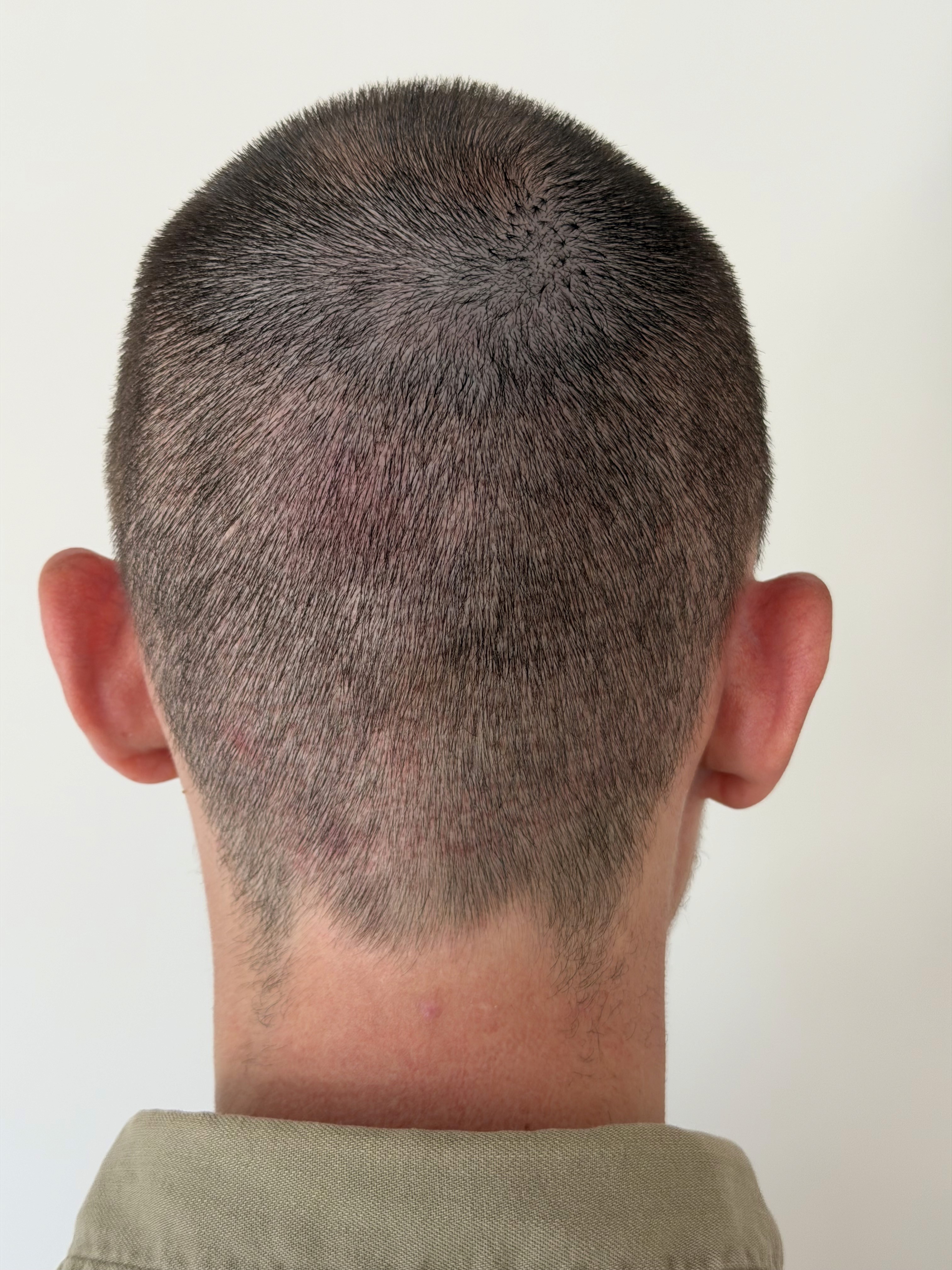
How responsible donor area planning supports natural-looking density today and preserves options for the future.
The donor area plays a central role in every hair transplant plan. It is the region—usually at the back and sides of the scalp—from which follicular units are harvested for transplantation. Unlike the recipient area, the donor area contains a limited number of usable follicles. Once follicles have been removed, they do not regenerate in that location. For this reason, protecting the donor area is essential for both the immediate appearance and the patient’s long-term options.
The donor area is a limited resource
A successful hair transplant is not measured only by how many grafts can be collected in one session. The aim is to achieve an appropriate improvement while maintaining balanced coverage in the donor area.
Removing too many follicular units—or concentrating extraction within a small region—may create visible thinning, patchiness or an uneven appearance. These effects can become more noticeable with short hairstyles, bright lighting or continued hair loss.
Conservative planning helps distribute extraction across suitable zones while preserving enough surrounding hair to maintain a natural appearance.
What determines donor-area capacity?
Donor capacity differs from person to person. It cannot be determined from a target graft number alone. A clinical assessment may consider:
• Hair density and the distribution of follicular units
• Hair calibre, colour and curl characteristics
• Scalp visibility and the contrast between hair and skin
• The size and stability of the safe donor zone
• Previous hair transplant procedures
• Scarring or scalp conditions
• The expected progression of future hair loss
• The size of the recipient area and the patient’s long-term goals
Two patients with similar patterns of hair loss may therefore have very different safe harvesting capacities. An individual examination is required before deciding how many grafts may be appropriate.
Why overharvesting matters
Overharvesting occurs when too many follicular units are removed or when extraction is distributed poorly. This can leave the donor area looking thin or irregular and may limit the possibility of corrective work in the future.
Possible signs may include visible gaps, patchy density, an unnatural contrast between treated and untreated areas, or increased scalp visibility. Because donor follicles are finite, correcting an overharvested area can be difficult.
A larger graft count is therefore not automatically a better treatment plan. The number harvested should be based on donor capacity, recipient-area priorities and long-term sustainability.
FUE does not make donor follicles renewable
Follicular Unit Excision, commonly called FUE, allows individual follicular units to be removed using small punches. Although it avoids a linear donor scar, each extraction still removes a follicular unit from the donor area.
The small extraction points usually heal individually, but the harvested follicles do not grow back in their original positions. If extractions are appropriately spaced, the surrounding hair can help maintain visual coverage. If too many follicles are removed, however, the reduced density may become visible.
The technique should therefore be considered a harvesting method—not a way to create an unlimited supply of donor hair.
Planning for future hair loss
Hair loss may continue after a transplant. A patient who appears to have adequate donor hair today may need additional treatment later if the recipient area becomes thinner.
Using too much of the donor supply during the first procedure can restrict future options. Long-term planning may involve prioritising the frontal area, choosing a conservative hairline and reserving follicles for areas that may require treatment later.
Age, diagnosis, family history, hair-loss stability, current treatment and realistic expectations should all be considered when developing this plan.
How Bonita Hair Clinic approaches donor-area protection
At Bonita Hair Clinic, donor assessment is part of the planning process rather than simply a calculation of the highest possible graft number. We consider donor density, hair characteristics, scalp condition, previous procedures, recipient-area priorities and the likely progression of hair loss. See Bonita’s hair transplant planning approach.
The objective is to recommend a plan that balances visible improvement with responsible donor management. When appropriate, this may mean limiting the number of grafts, adjusting the treatment area or planning the restoration in stages. Learn more about FUE donor-area planning.
Patients should also follow the personalised aftercare instructions provided by their clinical team. During the early healing period, the donor area should be washed and protected as instructed, and any unexpected pain, discharge, increasing redness or other concerns should be reported to the clinic.
This article provides general information and does not replace an individual medical assessment. Suitability, graft availability, risks and expected outcomes vary from person to person and should be discussed during consultation.
International Society of Hair Restoration Surgery. Follicular Unit Excision (FUE) Resources and Terminology.
https://ishrs.org/fue-research-2/
International Society of Hair Restoration Surgery. FUE Hair Transplant: Benefits, Process & Recovery.
https://ishrs.org/fue-what-is-it/
Rassman WR, Bernstein RM, McClellan R, Jones R, Worton E, Uyttendaele H. Follicular unit extraction: minimally invasive surgery for hair transplantation. Dermatologic Surgery. 2002;28(8):720–728.
https://pubmed.ncbi.nlm.nih.gov/12174065/
NHS. Hair transplant: overview, suitability, procedure and potential risks.
https://www.nhs.uk/conditions/cosmetic-procedures/hair-transplant/